Root Definition

If an organisation exists to create and operate a system, a root definition describes what the system is and what it aims to achieve; not in a strict mechanistic way, but taking account of the persons who could be affected by it, who would be part of it, or who could affect it in some way. It also defines the transformation that should be taking place and the environment that surrounds and influences the system.
The mnemonic CATWOE is used as a checklist to help ensure that all the necessary components are present in the root definition. CATWOE comes from:
- Clients or customers of the system,
- Actors who carry out the activities within the system,
- Transformation, the change that takes place within or because of the system - the conversion of input to output,
- Worldview - how the system is perceived from a particular viewpoint - sometimes described as "assumptions made about the system",
- Owner of the system, to whom the system is answerable,
- Environment that surrounds and influences the system.
Depending on the nature of the system being explored, one or several root definitions may be developed based on different, explicit viewpoints. One general root definition can provide a solid common understanding of a system and help build consensus within a group. Several root definitions based on different viewpoints may give a richer insight into the true nature of a system.
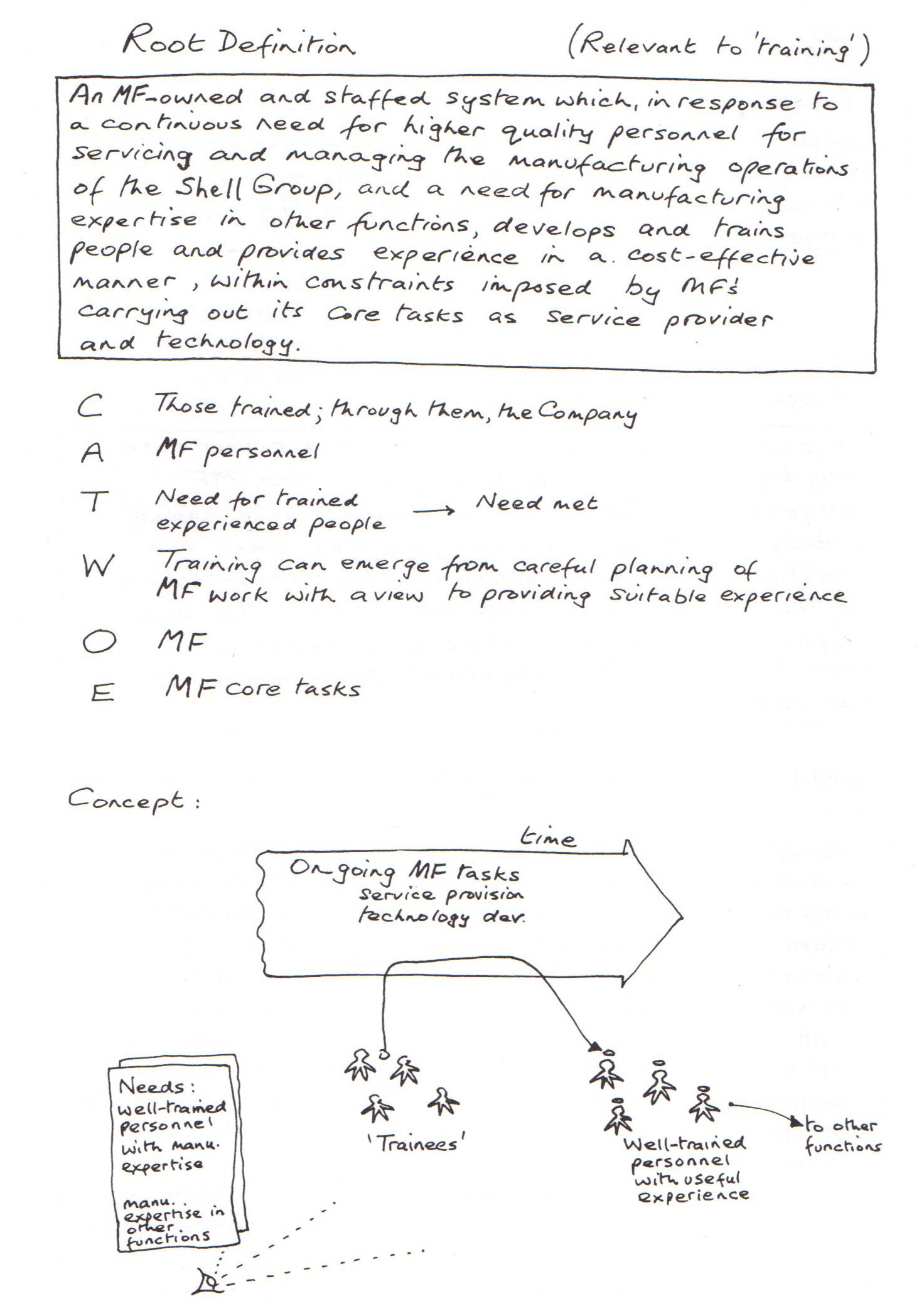
Root definition and CATWOE for a Shell Group Manufacturing Function (MF) training group, “Soft Systems Methodology in Action”, Peter Checkland and Jim Scholes, 1990, Wiley.
Thinking about our cellar door:
- Clients: Those people (Cellar Door customers) who come to the cellar door to try and buy the wine, some of whom will have a meal while they are there.
- Actors: Cellar door staff who run wine tastings and sell wine, front of house staff who take meal bookings, seat people at tables, take food orders, deliver food and take payments.
- Transformation: Grapes into wine, wine sold as a product people want to buy and enjoy. The Cellar Door provides the context for the wine's story and an important point of sale.
- Worldview: People understand they can visit the Cellar Door to taste and buy wine and learn more about it.
- Owners: The owners of the Cellar Door.
- Environment: The Cellar Door exists in the context of a wine region with other cellar doors. Paid advertising and social media influencers promote the area as a wine and food tourist destination.
Translating that into a root definition has several possibilities. Following is an example:
The Cellar Door is a system for selling wine by providing customers with an attractive and interesting environment in which to taste and learn about wine, where Cellar Door staff can encourage sales of wine through stories relating to terroir and grape variety and which allows customers to experience the wine paired with food, to buy wine, and sign on to the mailing list.
Is the CRM system that we can envisage at the moment going to support that root definition? Well, yes. If the CRM system allows us to keep track of who is buying which wines and in what quantities, it will allow the Cellar Door to build up a profile of that customer. If they sign on to the mailing list, the CRM could then be used to provide them with information on their preferred wine styles and types and how the next year's vintage is progressing, all with a view to turning those customers into regular buyers.