Business Process Models
Business process modelling (BPM) is a graphical notation, backed up by a standard, that allows organisations to draw or map out their business processes. If the business capability model identifies discrete capabilities within an organisation, a business process model shows the activities needed to deliver those capabilities. A process model could describe one capability or show how several are linked together.
Business process models are great at capturing an organisation's intellectual property (IP). If an experienced person knows how to do something and they can capture some of that expertise in a business process model, the organisation has secured some of its IP. That model can be used for training purposes and gives the organisation a chance to review and optimise the way it works.
However, for business process models to be effective they have to be considered living entities. There is little point expending effort developing models if they then get locked away in a drawer. Keeping models front of brain and up to date takes effort and has to be a learned organisational behaviour.
In some situations business process models can be used as the guide for tailoring large, generic ERP and CRM systems.
The famous guide to business process modelling was produced by the Berliner BPM-Offensive and is available for free from here.
In our Cellar Door example, BPM may be an appropriate way to explore just how a CRM would be used - what would users expect to be able to do and how would they do it. However, BPM takes quite a lot of time and effort so you would need to be convinced the insights you gain are worth it. In the first instance complete a "quick and rough" BPM.
Following is a snippet of a large business process model dealing with the operation of accounts in a road tolling company.
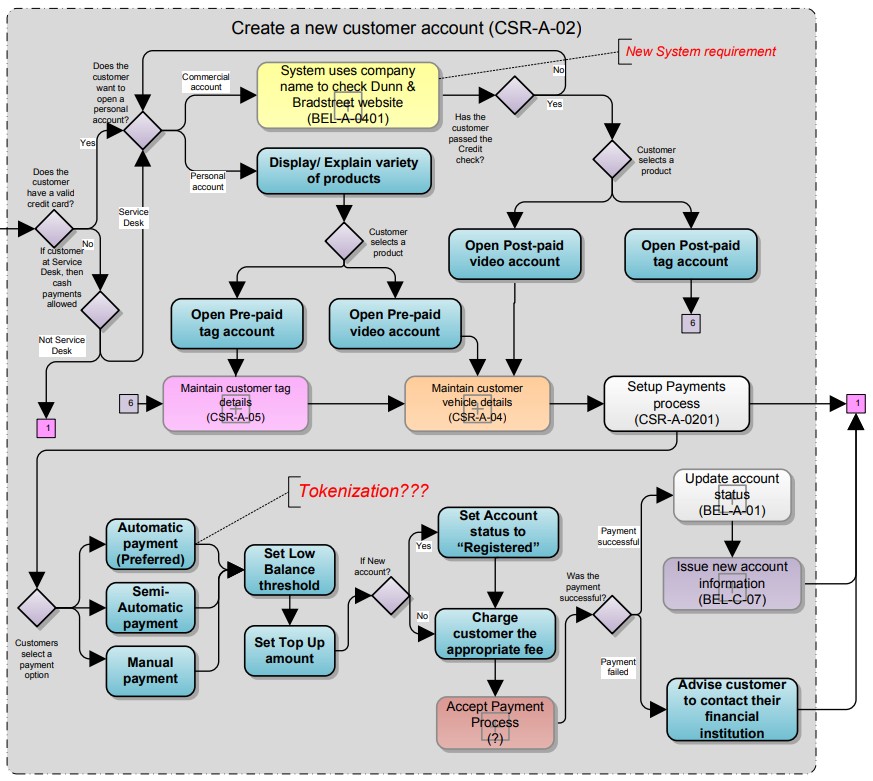
An example using business process modelling to describe an account opening process.